> For the complete documentation index, see [llms.txt](https://docs.concurrence.com/llms.txt). Markdown versions of documentation pages are available by appending `.md` to page URLs; this page is available as [Markdown](https://docs.concurrence.com/channels/conversations.md).
# Overview
How voice, text, messaging, email, and Surfaces deliver a shared workflow while preserving distinct identity, consent, and completion rules.
Channels determine how a workflow reaches a patient and how its responses become speech, messages, or forms. Supported agent paths can reuse agent guidance, Context Graphs, tools, and selected world-model context. Identity, consent, timing, session continuity, and operator controls still belong to the specific path.
A patient might answer a call, complete a browser form, and receive a later reminder. Coordinating that work requires an explicit workflow and shared context; it does not imply one uninterrupted conversation state across every transport.
## How It Works
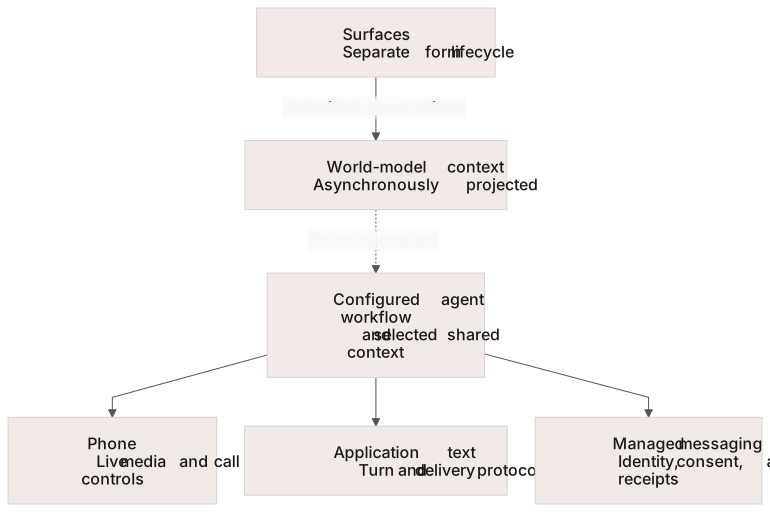
The [reasoning engine](/agent/reasoning-engine.md) processes available interaction signals and produces effects such as responses and tool calls. The selected runtime handles the channel's input, delivery, and control behavior. Surfaces provide a separate form-collection lifecycle that can contribute observations to the world model.
When adapting a workflow to another channel, review the information it needs, available tools, consent requirements, identity rules, and evidence of completion. Test those boundaries on the intended path. [How It Works](/platform-overview/how-it-works.md) follows one operational outcome through the wider system.
Shared configuration and context do not create one continuous session across these paths.
## Channel Types
### Phone
[Phone](/channels/voice.md) provides real-time conversations with speech recognition and generated speech. Supported paths include inbound and outbound calling, interruption handling, optional emotion analysis, and human escalation. Use the voice chapters for the audio pipeline and recordings, and [Operators](/operations-and-safety/operators.md) for phone-based listen and takeover.
### Text Sessions
[Text Sessions](/channels/text-sessions.md) explains application-hosted text and durable messaging conversation behavior. Applications and managed channels expose different response and completion contracts. Use this guide to understand continuity, request completion, and background work before implementing the channel-specific integration.
### SMS
[SMS](/channels/sms.md) uses provisioned sender resources and managed inbound routing. Review registration, consent evidence, content checks, suppression, and delivery receipts before planning outreach. A supplied phone number and a successfully created conversation do not establish permission to send or recipient delivery.
### WhatsApp
[WhatsApp](/channels/whatsapp.md) uses a business-scoped recipient identity for managed text conversations and applies a free-form reply window. Its separate phone-keyed voice-note operation has its own session and audio-delivery contract. Do not treat the two paths as one shared thread.
### iMessage
[iMessage](/channels/imessage.md) provides managed messaging through provisioned lines on compatible devices. It uses the durable conversation model with its own provider, media, and delivery boundaries. SMS and iMessage support an explicit switch within a compatible conversation; other channel transitions need their own workflow.
### Email
[Email](/channels/email.md) has managed sender domains, transactional or marketing use cases, reply threading, and separate delivery and unsubscribe evidence. Its send path is distinct from the Conversations API's outbound-start and channel-switch capabilities. Use the email guide for domain setup and sending behavior.
### Surfaces
[Surfaces](/channels/surfaces.md) collect structured input in a browser form. A configured workflow can create a form and share its supported email or web link, then use the submitted information. Form creation, link delivery, submission, and world-model projection are separate milestones. A Surface submission is not automatically a dataset-intake file.
### Voicemail
The standalone ringless voicemail channel has been retired. Answering-machine and configured voicemail behavior during a regular phone call remain part of the voice workflow.
## Background Tool Delivery on Non-Live Channels
Live voice, application text, and asynchronous messaging expose different completion contracts. An application turn can complete within its request or require the client to inspect pending work. Managed messaging can attempt a later reply when supported background work completes.
Provider delivery remains separate. Suppression, rejection, retries, or an outage can prevent that reply from reaching the recipient. See [Text Sessions](/channels/text-sessions.md) and the relevant channel guide for the supported lifecycle.
## Multi-Channel Orchestration
Choose channels through provisioned use cases, authored workflows, triggers, and supported outbound operations. Patient preferences, consent, contact history, and the information being exchanged should inform that configuration.
For each transition, decide which entity and history the next step can access, what starts it, what confirms completion, and who handles a failure. Shared world-model context can support continuity even when the transports retain separate session state. Automatic cross-channel optimization or fallback should not be inferred from that shared context.
### Outbound
[Outbound](/channels/outbound.md) explains platform-initiated contact and scheduled work. A campaign also needs explicit eligibility, pacing, consent, retry, and exception policy. A channel's availability does not supply those policies automatically.
### Channel Availability
Use [Channel Program Readiness](/channels/program-readiness.md) to distinguish a working channel from an approved outreach program, then assign the recurring software and operating responsibilities for that program.
Availability depends on the deployment, geography, provider capacity, and completed provisioning. Managed SMS, iMessage, WhatsApp, and email resources can require Concurrence-assisted onboarding. Confirm the intended resources and routing before exercising the workflow.
## Continue the Deep Dive
Read the relevant channel guide for transport behavior, [Runtime Safety](/operations-and-safety/runtime-safety.md) for enforced and observed controls, and [Testing and Evaluation](/testing/testing.md) for evidence that covers the actual channel. The [Operating Model](/platform-overview/operating-model.md) assigns consent, staffing, and exception responsibilities.
---
# Agent Instructions
This documentation is published with GitBook. GitBook is the documentation platform designed so that both humans and AI agents can read, navigate, and reason over technical content effectively. Learn more at gitbook.com.
## Querying This Documentation
If you need additional information that is not directly available in this page, you can query the documentation dynamically by asking a question.
Perform an HTTP GET request on the current page URL with the `ask` query parameter, and the optional `goal` query parameter:
```
GET https://docs.concurrence.com/channels/conversations.md?ask=&goal=
```
`ask` is the immediate question: it should be specific, self-contained, and written in natural language.
`goal` is optional and describes the broader end goal you are ultimately trying to accomplish on behalf of the user. GitBook uses it to tailor the answer towards what is most useful for that goal.
The response will contain a direct answer to the question and relevant excerpts and sources from the documentation.
Use this mechanism when the answer is not explicitly present in the current page, you need clarification or additional context, or you want to retrieve related documentation sections.